
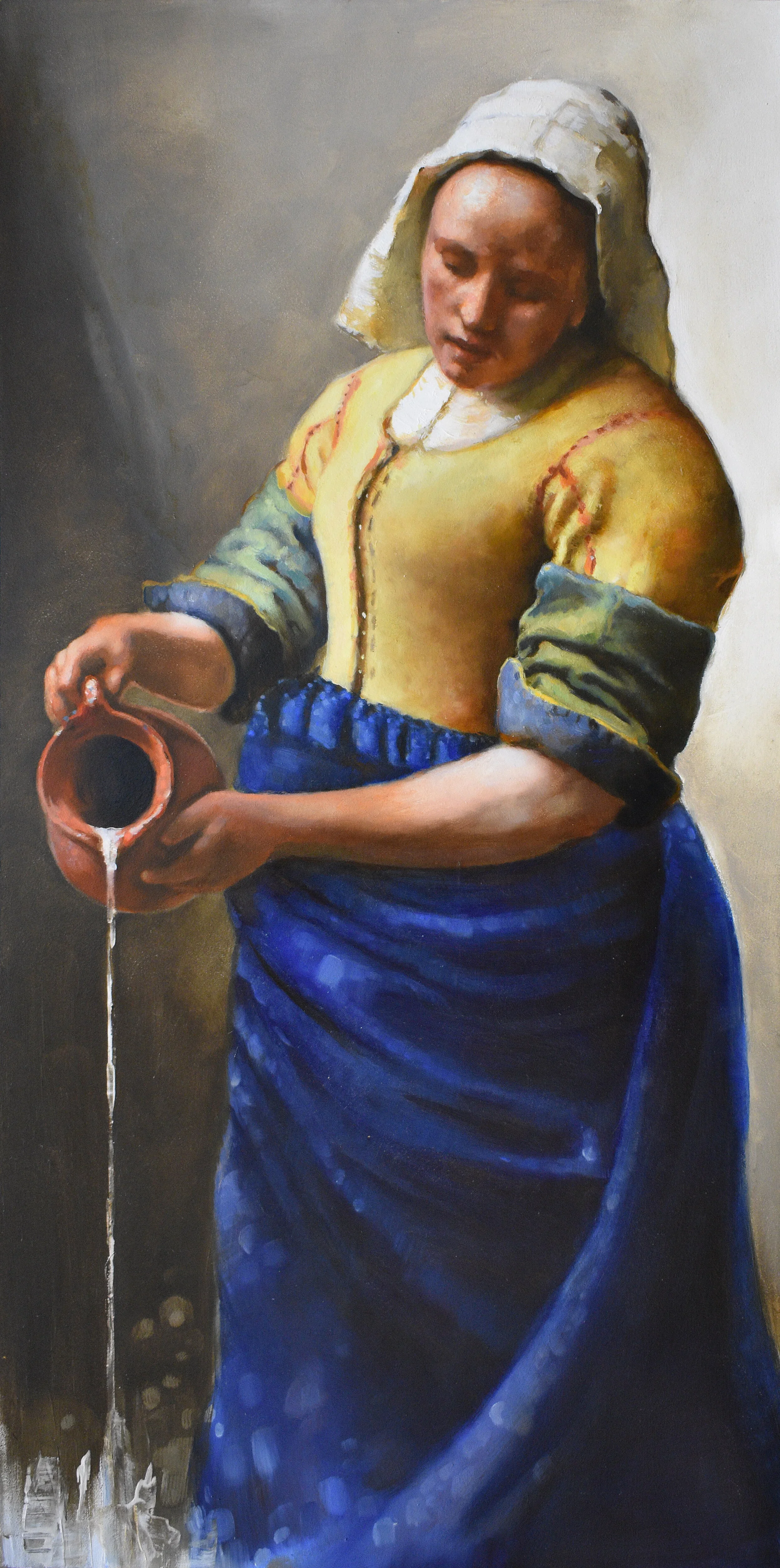
The History of Attention:
We don't hunt for 'Van Eyck' because we want to connect with a 15th-century human; we do it because the name acts as a classification system—the 'Intel Inside' sticker for a canvas. But if an algorithm can successfully uncover a pattern that suggests a painting isn’t by a specific master, it doesn't mean the work has lost its inherent greatness; it means our criteria for 'greatness' has become dangerously superficial. By stripping away the 'Algorithm of Attribution,' AI serves as a clarifying lens, forcing us to ask the only question that matters: Does this work speak to me, regardless of the name on the plaque?

To be or not to be a painting by Byam Shaw?
A brief description of finding the true identity of the artist who atucally painted the painting in question. It was previously attributed to Byam Shaw, but we now know with out a doubt that it was actually done by Francis Sydney Muschamp.

Conserving a late 19th century French Painting by Henri Thierot
Henri Thierot was a French painter active in the late 19th century (1863-1905). A good example of both French Naturalism and Symbolism

First official acquisition
The official start of my art collecting journey. A small oil painting by the late 19th century art Sarah Louis Kilpack.

Why Narrative Paintings are better labeled as Implied Narratives.
Oil Painting by Joshua Adam Risner

The Archeology of Allegory
The reputation and role of allegory has fluctuated throughout its long history. It has gone from being a valuable mode of interpretation for poets and philosophers to a manipulation tool for politics and preachers. For the past two centuries, due in part to its insistence on looking backwards and reliance on historical knowledge, allegory was condemned “as aesthetic aberration or the antithesis of art”. However, in the recent past allegory has re-emerged as a viable mode of exploration. This begs the question, what has changed that has allowed allegory to re-emerge? To answer this question a brief look back at the history is required. The goal of this exploration into allegory is to reveal the stimulus for its fluctuation, as well as what makes it still relevant today.


Structures, a game tug of war?
Short essay about the artist Charles Caldemeyers body of work titled Structures.

Grids and Structures, Structures and Grids
A short essay about Charles Caldemeyer’s Body of work called Grids.